
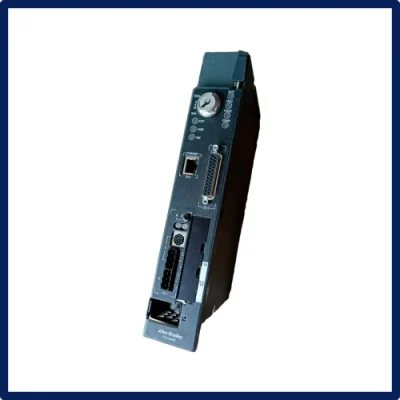
Description
Overview
The PROCESSOR CENTRAL PROCESSING UNIT – 1785L40E is a powerful Programmable Logic Controller (PLC) for medium and large automation applications. Moreover, it delivers reliable performance while interfacing with multiple devices simultaneously. This controller ensures smooth automation of machines or processes, reducing downtime and improving operational efficiency.
Flexible Installation and Compatibility
Designed to be installed in a 1771 chassis, the 1785L40E controller draws 3.3A and dissipates 17.3W of power. Compatible chassis include 1771-A1B, 1771-A2B, 1771-A3B, 1771-A3B1, and 1771-A4B. Additionally, compatible power supplies are 1771-P4S, -P6S, -P4S1, and -P6S1. Therefore, integration into existing systems is straightforward and efficient.
Advanced Communication Capabilities
The PROCESSOR CENTRAL PROCESSING UNIT – 1785L40E supports multiple industrial protocols through embedded ports. These include two Data Highway+ / Remote I/O combination ports, one serial port supporting RS-232, RS-423, and RS-422A, and one Ethernet port with 10/100 Mbps speed. Consequently, it enables seamless communication with PLC5 controllers, visualisation systems, and other Allen-Bradley devices.
Versatile Programming Support
This controller adheres to IEC 61131-3 standards and supports several programming languages. Users can program with Ladder Logic, Structured Text (ST), and Sequential Function Chart (SFC). Therefore, developers enjoy flexibility when designing complex control applications. Furthermore, these standards ensure consistent and reliable operation across multiple projects.
Key Benefits at a Glance
-
Medium to large PLC for industrial automation applications
-
Compatible with multiple 1771 chassis and 1771 power supplies
-
Embedded communication ports for seamless networking and integration
-
Supports Ladder Logic, SFC, and Structured Text programming
-
Reliable, high-performance operation for demanding industrial environments
In conclusion, the PROCESSOR CENTRAL PROCESSING UNIT – 1785L40E provides robust control, versatile connectivity, and flexible programming support. Therefore, it remains an essential component for modern industrial automation systems.

There are no reviews yet.